
Notes on the Maldives Expo 2026

Day 1

This is the 28th of October 2026. Day 1 of yet another expo occupying, the inaptly named, Central Park of Hulhumalé. Where this years esteemed and anticipated Dhivehi Ufehdhuntheri Kamuge Maurazu (DUKM) was held. Central Park is the biggest “park” around these parts of central Raajé. Formally called such, more lovingly called expo park lately. Just like any other most weekend or weekday, it does not matter, there is an implicit assurance of an expo being held here. An imposed, bastardised and artificial park implanted on a manmade island that masquerades as a city. Faux city, faux park and faux culture. For, whatever is left of, culture’s sake, I plunge myself into this.
With as little context and information as possible, to expose myself to an exhibition of what scale or purpose unknown. What purpose this expo serves only god knows and as I am only human I will use my god endowed ability to go find out, observe and reflect.
The marketplace district
I start with the market place area, which you must pass to enter into the heart of the expo.
The stalls of the DUKM marketplace in great part showcased borrowed excellence of foreign cultures and international delicacies. Sushi, steak, pani puri, momo’s and the likes. Presumably some made by the hands of Maldivians, and not entirely the hands of overworked and underpaid migrant workers.
Desperate to beat the heat and dehydration, I looked around to purchase a drink. Menus with prices on them were rare and far-between. Whatever and most of the informative graphics and images around seem to ooze under the influence of AI. The surge of masses gather in front of stalls, vying for the attention of vendors, and create human traffic jams. The smells, sweat and sheer human density only adds to the confusion in this psychological war to consume.
In utter confusion I end up with a reddish drink; one cup, nearly unfilled to the brim, chia seeds, mushed strawberries, mint, flat and no ice. I lose out on MVR 80 with this purchase, just MVR 5 short for a ticket to one of the “biruveri hoholha” (scary hole is the literal translation). Mostly regret remains in the food stalls of the marketplace of DUKM. For some reason, unsatisfied with the reality of the modern Maldivian palate, I chased after some more snacks. After another battle in front of a food stall with elusive prices, MVR 100 vanish from my hungry peer’s wallet. We end up with a small plate of snacks; one takeaway tray, fries, lumps of fried chicken, drowned in gravy, some poor ass disposable utensils to tackle the a meagre portion. It is no surprise one stab of the wooden fork left a chicken piece fleeing to the ground.
“Ihusaas vanee hoonukann, meehunn ginaee, kaa ehchis agubodee, vanee udhaas” the peers utter.

The food district may be void of context, navigation and breathing room but it is amply generous in the steam, grease and heat of multiple kitchens. The high prices were a reflection of the high costs it takes to create in this country. The stalls did not come free to the vendors, entrepreneurs, mom and pops. Bulking up on stock, extra manpower and effort it takes to meet the demands of an expo is expensive. Travel from different parts of Raajé to reach Malé is expensive, to stay here is also expensive, and to breathe or even exist in Malé is expensive. On top of it, some fees to even participate and open a stall in the first place. Whether it be; consumables, wearables, vanity displays or intangible commodities, it is all outrageously priced to no avail or enough benefit for the creators and consumers alike.
Beyond the trendy options of food items is where Maldivian ingenuity in traditional food-craftsmanship shines. Fuvamulah kanamdu meta, Dhuvafaru majaa, Huvadhoo Raaulhali ice-cream, and, as expected, an assortment of crunch fried spicy tidbits of Raajé all in one place. Kaajaa, athujehi, kudhi gulha and such. A feat only this very expo can accomplish; a collection of Maldivian cuisine’s finest, its innovation and its compiled showcase. I have to give a special mention to the decadent and creamy Kashi keyo kandhi for MVR 35, rare to come across in this city. As well as acknowledge the kashikeyo doughnut along with the brilliant saleswoman who offered a free pani; puri to hook, line and sink me into purchasing it. MVR 15 was a no brainer for me to try something I would not have otherwise.
In spite of it all, the Magu of the marketplace proved to be a decent snapshot to take a peek into the gastronomical literacy of Maldivians. As well as what we seek for when we attempt to sate the emptiness in our stomachs. The food here tonight is either modernity imported or tradition to export, and both commercialised.

The introduction to DUKM through the food politics of this marketplace left me standing in the heart of the Expo. Districts from all sides greet you, all six of them and the map served little utility aside for being placed around as an uninformative infographic. The stalls had no numbers, index, code or identifiable markers as navigational cues to conquer this beast of an expo with over 700 stalls.
700 stalls divided into four quarters of the bastardised circle/roundabout of central park. The expo bursts at the seams with more sections than four for sure; more districts than one would assume, too packed and dense than ever expected, three hours insufficient to thoroughly and lazily browse through this mammoth of an expo. I decide to overcome this expo through some nights of the week. After glancing at a queue in front of the star of the expo, the maurazu unit, I turn towards the creative economy district.
The creative economy district and gropexco revelation
Keychains, shades, stickers, prints, lino cuts, jewellery and the likes, all handmade by Maldivians. A delight to loiter around in, under most circumstances. Except for this time. Man, woman or child, you will leave unscathed from an unintentional and unwanted grope and feel. There is an absence of gaps and breathing room, having stalls in the middle of an already spatially challenged pavilion did not help. Gropexpo/ungulhey Ufehdhuntherikamuge Maurazu. I ask around to make sure I was not the only one undergoing this invasion of personal space and boundaries around the expo. Most I encountered agreed.
Then the rest of the marketplace district and the coconut craftsman uncle
I leave this pavilion and empty the rest of the market magu. Consistently atrocious prices with few worthwhile budget bites here and there, the prices of menus remain a mystery and the options were consistently homogeneous.
However, an artisan from did have wares that piques my interest. Jewellery and little trinkets made from the different life stages of a palm fruit. The different life stages of the palm fruit requires different approaches and techniques, resulting in different finished outcomes at most times. The fish earring made of mature coconuts are a darker walnut with a brilliant shine while the same fish earring made of immature coconuts are a paler oak with a subtle matte.
In modern day Raajé with easy access to imported plastic, clay, plaster and its kin to mould pour into any shape, these earrings stood out to me. Same tree, same fruit, but at different times and finishes.

If you look beyond the sheen, shimmer and finish of the intangible cultural heritage here, you will see an abyss of valuable knowledge. Terminologies, description, and characteristics of our natural resources. Condition, climate and temperament of our natural environment. Intangible cultural heritage does not begin or end with a finished product; jewellery, clothes, furniture or else. It started through techniques carried over time, honed over generations and some intricately irreplicable.
Boduberu competition
I end the night listening to boduberu, or whatever remains after intense and rapid modernisation. On a stage, with microphones and a sound system. Bright lights, screens and potential epilepsy bait. Shortened songs, omitted buildups and abrupt starts. Big openings carried through to what end? Mere minutes to convey advice, history and community? To experience the finery of traditional music in its actual form? The crowd moves nonetheless.
“Bodu biya kujjeh” echoes from one of the judges mic without any hesitancy. Consistently, the criticism were crude without a doubt, blunt honesty. The awkward silence between the judges’ tough love, proved to be some form of modern torture technique that, kept pulling the audience out of the substance free trance of bodu beru. I leave with a berucockblock.
Day 2
Dhivehi Ufehdhuntheri Kamuge Maurazu
It is day 2 of the DUKM. Of which some parts I had somewhat conquered the night prior, tonight my eyes are on the air-conditioned palace of a pavilion, holding and hosting the winners and mentions of the DUKM. The queue is horrendous and the human generated humidity becomes more unbearable by the minute. The crowd slowly inched towards the mouth of an entrance which was also the exit, similar to a sea cucumber who also consumes and expels from the same hole.
The ceilings were high, the human density more humanely bearable, and the air cooler than any spot of this expo. Breathable, bearable and walkable aside for the opening/closing of the pavilion slightly constipated with visitors. The vendors names are below eye level, to my crotch level rather. Why wouldn’t the organisation team have labelled the names better for the eyes to see? Once again, there was no map, not much semblance of categorisation, if there were any it was kept a secret from the visitors.
I slowly glazed my greedy eyes over the finery here. I wonder if there could be a price we can put on Raajé’s finest. Thundu kunda (thatch weave) from Gaafu Dhaalu, Liyelaa (lacquer work) from Baa, Roanu (coir rope) from Haa Dhaalu, Libaas (traditional dress of Raajé) from Seenu and so much more intricate finery. None of our traditional crafts are easy on the bodies of its practitioners; they take a toll on the eyes, hands, bones and all.
Stand close enough to look into the grids that birth a kunaa. Grab a magnifying glass to behold the fine lines of etched wood peeking through layers of lacquer. Attempt to find a flaw and weakness in the strength of the coir rope here. Run your fingers through the gentle curves of the gold, silver and coloured threads of a libaas. A justifiably boastful showcase of Maldivian intangible cultural heritage and moreso intricate craftsmanship.
Kavi kamaai hedhi saharoa fadha ey. Miee haadha bodu barakaathakaai, hithah libey aniyaa ehvesme. What happens to my people, our identity and our pride when all of this dissipates further and further into oblivion? Banned raw materials have long stifled the intangible culture and heritage of Raajé. In lieu of endheri (black coral), muraka (coral), and kahanbu thoshi (turtle shell) this expo seems to have a growing abundance of a recycled plastic to play with.

Such jewellery catch my eye and the sales pitch by a young vendor enter my ears. Clearly it was plastic melted and remolded to a another form, a verbal explanation was unnecessary. “What of the toxic fumes?” I ask. The answers were; masks, open windows and ventilation. In addition to the implication on our health and environment to absorb pollution, but I did not say that out loud. This exhibit had many more pieces and creations made from the plague that is single use plastic. Our resilience and perseverance through adversity shows through the recycled art present here.
Perhaps if the recycled plastic had more finish and refinement to it, I would have spent a penny or two to support this emerging Dhivehi ufehdhuntherikann. Alas, I have seen and witnessed some iota of the Maldivian excellence there is in crafts of adornment.
The rest of the Maurazu had more of more recent additions to the tapestry of Dhivehi Ufehdhuntherikan. More literature; children’s books, young adult, educational material. An introduction to sewing in my mother tongue was a delightful Dhivehi Ufehdhunn. Moreover, games, stickers and trinkets. Then textiles, needle work and work woven. The modern addition of items of Maldivian creations from broader popular culture could overpower the historical artefacts of mine and our past. However, this exhibition seemed to have a fine line in the balance.
The Digital and Innovation district
Haman AI greets the corner of my eye as I enter this pavilion. AI, some more AI and then even more AI. The digital pavilion seemed to fighting a battle not too different from the traditional craft pavilions. Rapid change that slowly removes the human from the digital processes. Perhaps one day the robots will inhabit this pavilion instead of human vendors. Would that also be Maldivian excellence?
Aside AI there were other assortments of digital creations. Apps, fonts, digital learning platform, institutions of higher education, prints of digital art. In addition to the wildcards that were; power tools and motorbikes?, Merihana (the writer)?, and Stelco? Stelco could be the god of all things digital and perhaps deserved to be the heart of the digital district. Stelco has a waterfall fountain and an electric ring game right beside it. I came back the following night I to try my hand at it to only notice its absence.
Live music
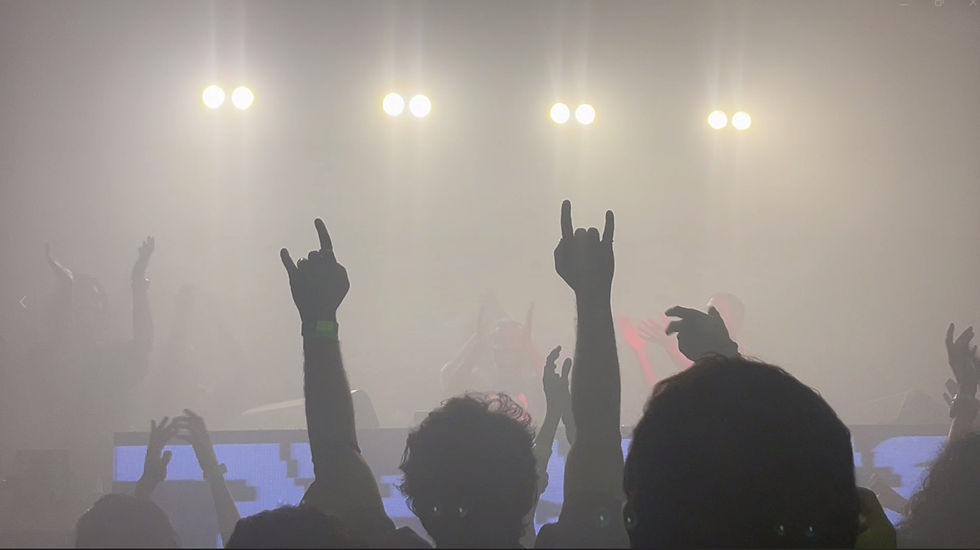
I show up to glance at Niyarodhi’s “rodhi” debut. By this point, I question myself, what am I doing here? To see Dhivehi ufehudhudhuntherikan? But the first question should be, what is Dhivehi ufehudhudhuntherikan? Thank you Niyarodhi, for this rhetorical revelation and also being the opening act for Detune Band.
The end
I end my adventures of DUKM with two purchases, three if you count my wits. Two keychains of Raabandhi from Haa Dhaalu, and the kehi fish earrings from Aliff Alif. I nibble the Kanamadhu metaa from Gnaviyani. I hold this loot as I dig through to find the papier-mâché liyelaa earrings I got from the last time the DUKM was held in Dharubaaruge of Malé. I guess that is the whole point of DUKM. A curated compilation of Maldivian heritage, culture and ingenuity in one venue ready for all to witness, immerse in and experience.


Comments